
Hand Litho Daybill Poster.Taggart is a 1964 American Color Western film directed by R. G. Springsteen and starring Tony Young, Dan Duryea, Dick Foran, Elsa Cárdenas and Jean Hale. The storyline is: Kent Taggart's family has their cattle stampeded and murdered. In a fair gunfight Kent kills the man's son responsible for it all but runs, causing a warrant to be issued and a price to be put on his head. It was the film debut of David Carradine (Kung Fu TV Fame).

Never Give An Inch (also known as Sometimes A Great Notion) is a 1971 American drama film directed by Paul Newman and starring Newman, Henry Fonda and Lee Remick. The cast also includes Richard Jaeckel in an Academy Award-nominated performance. The screenplay by John Gay is based on the 1964 novel of the same name by Ken Kesey, the first of his books to be adapted for the screen. Filmed in western Oregon during the summer of 1970, it was released over a year later in December 1971. Sam Peckinpah and Budd Boetticher had expressed interest in bringing Ken Kesey's novel to the screen but Richard A. Colla was signed to direct the film. Colla left the project after 5 weeks shooting due to "artistic differences over photographic concept," as well as a required throat operation. At the same time, Paul Newman broke his ankle, and the production shut down on July 29. As co-executive producer, Newman considered replacing Colla with George Roy Hill (Butch Cassidy fame), who declined the offer, so when filming resumed two weeks later, Newman was directing as well as acting. The film's theme song, "All His Children", with music by Henry Mancini, is performed by Charley Pride and was nominated for an Oscar. Newman’s directing was well received by critics.

Send Me No Flowers is a 1964 American Technicolor comedy film directed by Norman Jewison and starring Rock Hudson, Doris Day, and Tony Randall. After Pillow Talk and Lover Come Back, it is the third and final film in which Hudson, Day and Randall starred together. The screenplay by Julius J. Epstein is based on the play by Norman Barasch and Carroll Moore, which had a brief run on Broadway in 1960.The title tune was written by Hal David and Burt Bacharach. The film was the last comedy for Doris Day and Rock Hudson to do together making it their third.

The Robe is a 1953 American Biblical epic film that tells the story of a Roman military tribune who commands the unit that is responsible for the Crucifixion of Jesus. The film was released by 20th Century Fox and was the first film released in the widescreen process CinemaScope. Like other early CinemaScope films, The Robe was shot with Henri Chrétien's original Hypergonar anamorphic lenses. The film was directed by Henry Koster (Harvey) and produced by Frank Ross. The screenplay was adapted by Gina Kaus, Albert Maltz, and Philip Dunne — although Maltz's place among the blacklisted Hollywood 10 led to his being denied his writing credit for many years — from Lloyd C. Douglas' eponymous 1942 novel. The score was composed by Alfred Newman, and the cinematography was by Leon Shamroy. The film stars Richard Burton, Jean Simmons, Victor Mature (originally Jeff Chandler was to play this role), and Michael Rennie and co-stars Dean Jagger, Jay Robinson, Richard Boone, and Jeff Morrow. The Robe had a 1954 sequel Demetrius and the Gladiators. The film was advertised as "the modern miracle you see without glasses", a dig at the 3D movies of the day. It was critically and commercially successful and was nominated for 5 Academy Awards ultimately winning two.
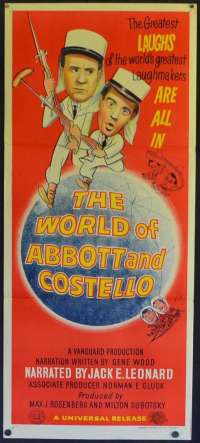
The World Of Abbott And Costello Daybill Poster original 1965.The World of Abbott and Costello is a 1965 American compilation film directed by Sidney Miller and starring the comedy team of Abbott and Costello. As mentioned above, this film is a compilation of scenes from eighteen films that Abbott and Costello made for Universal Pictures between 1941 and 1955. Comedian Jack E. Leonard provides the narration. A year earlier, MGM Pictures released a compilation film, MGM's Big Parade of Comedy, which includes a scene from the Abbott and Costello film, Rio Rita. The World of Abbott and Costello was theatrically released by Universal Pictures in 1965 as part of a double feature with McHale's Navy Joins the Air Force. At the time of release, Lou had previously died on March 3, 1959 and Bud Abbott had been enduring financial difficulties but found work providing the voice to a cartoon version of the Hanna-Barbera animated series The Abbott and Costello Cartoon Show.

Daybill Poster.Those Daring Young Men in Their Jaunty Jalopies (Monte Carlo or Bust! as it was known in UK/France/Italy) is a 1969 co-production comedy film. The story is based on the Monte Carlo Rally – first raced in 1911 – and the film recalls this general era, set in the 1920s. A lavish all-star film (Paramount put $10 million behind it), it is the story of an epic car rally across Europe that involves a lot of eccentric characters from all over the world who will stop at nothing to win. The film is a sequel to the 1965 hit Those Magnificent Men in their Flying Machines. Terry-Thomas appeared as Sir Cuthbert Ware-Armitage, the equally dastardly son of the Sir Percy Ware-Armitage, which Thomas had played in the earlier film. Tony Curtis and Susan Hampshire played other contestants in the race; Curtis also starred in the similar period-piece comedy The Great Race (1965) from Warner Bros. Some others of the cast from the first film returned, including Gert Fröbe and Eric Sykes. The writer and music score was by the same people who did the first film- Those Magnificent Men in their Flying Machines. At the time of release it was favourably received by audiences and critics alike.
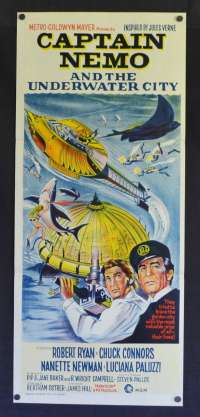
Captain Nemo and the Underwater City is a 1969 British film starring Robert Ryan, Chuck Connors and Nanette Newman. It features the character Captain Nemo and is inspired by Jules Verne's novel Twenty Thousand Leagues Under The Sea. It was written by Pip and Jane Baker. The film was produced on a budget of 1.5 million US dollars. It had stemmed from an idea that led to Roger Corman’s failed Captain Nemo and the Floating City, itself based on a combination of two of Jules Verne’s stories. Though that movie never passed the planning stage, MGM producer Steven Pallos managed to re-create the project having read a series of inspirational articles about Jacques Cousteau’s experiments with deep sea habitats, and the 'floating' was changed to 'underwater'. The film drew heavily on the supposed charm of the Victorian era, following an agreement between director and scriptwriters to produce a popular escapist atmosphere, more the essence of Michael Todd’s Around the World in Eighty Days than of Disney‘s 20,000 Leagues Under the Sea.

Great Bob Peak poster artwork on this rare window card.The Cincinnati Kid is a 1965 American drama film. It was directed by Norman Jewison and stars Steve McQueen in the title role and Edward G. Robinson as Howard. Spencer Tracy was originally cast as Howard, but ill health forced him to withdraw from the film. Jewison replaced original director Sam Peckinpah shortly after filming began and considers it the film that allowed him to transition from the lighter comedic films he had previously been making and take on more serious films and subjects. The film tells the story of Eric "The Kid" Stoner, a young Depression-era poker player, as he seeks to establish his reputation as the best. This quest leads him to challenge Lancey "The Man" Howard, an older player widely considered to be the best, culminating in a climactic final poker hand between the two. The film features a theme song performed by Ray Charles. The film garnered mixed reviews from critics on its initial release but of more recent times critics have cited McQueen was "effortlessly watchable as the Kid, providing a masterclass in the power of natural screen presence over dialogue" and Robinson "simply fantastic." Supporting actors Robinson and Joan Blondell earned award nominations for their performances.

USA Window Card.Zorba the Greek is a 1964 British-Greek comedy-drama film written, produced, edited, and directed by Greek Cypriot Michael Cacoyannis and starring Anthony Quinn as the titular character. Based on the 1946 novel, The Life And Times Of Alexis Zorba by Nikos Kazantzakis, the film's cast includes Alan Bates, Lila Kedrova, Irene Papas, and Sotiris Moustakas. The film was shot on location on the Greek island of Crete. Specific locations featured include the town of Chania, the Apokoronas region and the Akrotiri peninsula. The famed scene in which Quinn's character dances the Sirtaki was filmed on the beach of the village of Stavros. The film was a smash hit. Produced on a budget of only $783,000, the worldwide gross was between $18.8 million to $23.5 million. It was the 19th highest-grossing film of 1964. Contemporary reviews were generally positive, with Anthony Quinn and Lila Kedrova receiving numerous accolades for their performances.
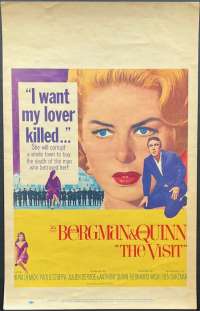
The Visit Poster Rare original USA window card.The Visit is a 1964 international co-production film from France, Italy, Germany, and the United States, distributed by 20th Century Fox. It was directed by Bernhard Wicki and produced by Darryl F. Zanuck and Julien Derode, with the film's stars, Ingrid Bergman and Anthony Quinn, as co-producers. The screenplay was by Ben Barzman, adapted by Maurice Valency from Friedrich Dürrenmatt's 1956 play Der Besuch der alten Dame (literally, The Visit of the Old Lady).Bergman and Quinn head a cast that includes Irina Demick, Paolo Stoppa, Hans Christian Blech, Romolo Valli, Valentina Cortese, Claude Dauphin, and Eduardo Ciannelli. The film was a study of the darker elements of human nature. The themes of the film, as with the play, are greed, revenge and corruption and the fact that money can buy anything, even justice. Power that comes from money can lead to hate, even murder and to the collapse of ordinary morality. Bernhard Wicki was nominated for the Golden Palm at the 1964 Cannes Film Festival and the film received a nomination for Best Costume Design-Black and White (René Hubert) at the Academy Awards.

Daybill Poster.The Magic Christian is a 1969 British satirical black comedy film directed by Joseph McGrath and starring Peter Sellers and Ringo Starr. John Lennon was originally intended to play the role of the orphan but it went to Ringo instead.Paul McCartney wrote the songs that were featured on the soundtrack and were performed by the band Badfinger (who were signed to the Beatles record company Apple). Other star appearances included John Cleese, Graham Chapman, Raquel Welch, Spike Milligan, Christopher Lee, Richard Attenborough, Roman Polanski and Yul Brenner. It was loosely adapted from the 1959 comic novel of the same name by American author Terry Southern, who co-wrote the screenplay adaptation with McGrath. The official soundtrack album featured other music as well; Badfinger released an album with its songs for the film, Magic Christian Music. The movie is often remembered for its song "Come and Get It",written and produced by Paul McCartney and performed by Badfinger. In popular culture today writer Grant Morrison named The Magic Christian as an inspiration for his Batman Incorporated series. The poster is now a collector’s item due to the Beatles connection.

Alice's Restaurant Poster Australian One Sheet Original 1969.Alice's Restaurant is a 1969 American comedy film directed by Arthur Penn (father of Sean Penn). It is an adaptation of the 1967 folk song "Alice's Restaurant Massacree", originally written and sung by Arlo Guthrie. The film stars Guthrie as himself, with Pat Quinn as Alice Brock (the real Alice Brock makes a number of cameo appearances in the film) and James Broderick as Ray Brock. Penn, who resided in the story's setting of Stockbridge, Massachusetts, co-wrote the story with Venable Herndon in 1967 after hearing the song, shortly after directing Bonnie & Clyde. Many of Guthrie's real-life associates in Stockbridge made appearances as extras. Alice's Restaurant was released on August 19, 1969, a few days after Guthrie appeared at the Woodstock Festival. It went on to be nominated for numerous awards including Best Director at the Academy Awards.

One Sheet Poster.The Swimming Pool (La Piscine) is a 1969 Italian-French film directed by Jacques Deray, starring Alain Delon, Romy Schneider, Maurice Ronet and Jane Birkin.Set in summertime on the Côte d'Azur, it is a drama of sexual jealousy and possessiveness. Both French and English-language versions of the film were made, with the actors filmed speaking English for the international release, which was unusual at a time when movies were always either dubbed or subtitled. That 114-minute international release, shorter than the French version, also had a slightly different editing.The movie was released in the UK as The Sinners and in Italy with twenty minutes cut, it was a commercial success.It was the fourth most popular movie at the French box office in 1969 and The Los Angeles Times called it a "handsome, stunningly designed film".

Australian One Sheet Poster.The Getaway is a 1972 American neo-noir crime film directed by Sam Peckinpah and written by Walter Hill, based on the 1958 novel by Jim Thompson. The film stars Steve McQueen, Ali MacGraw, Ben Johnson, Al Lettieri, and Sally Struthers. The plot follows imprisoned mastermind robber Carter "Doc" McCoy (McQueen), whose wife Carol (MacGraw) conspires for his release on the condition they rob a bank in Texas. A double-cross follows the crime and the McCoys are forced to flee for Mexico with the police and criminals in hot pursuit. Peter Bogdanovich, whose The Last Picture Show impressed McQueen and producer David Foster, was originally hired as the director of The Getaway. Thompson came on board to write the screenplay, but creative differences ensued between him and McQueen and he was subsequently fired along with Bogdanovich. When Bogdanovich was to direct, he intended to cast Cybill Shepherd, his then girlfriend, in the role of Carol. As soon as Peckinpah came on to direct, he wanted to cast Stella Stevens with whom he had worked on The Ballad of Cable Hogue (1970), with Angie Dickinson and Dyan Cannon as other possible alternatives. Thus Ali MacGraw was not a first choice by either director. Principal photography commenced on February 7, 1972, on location in Texas. The film reunited McQueen and Peckinpah, both of whom had previously worked together on the relatively unprofitable ‘Junior Bonner’ which was released the same year. The Getaway opened on December 13, 1972 and was a box office hit earning over $36 million. It was the second highest-grossing film of the year, and was one of the most financially successful productions of Peckinpah's and McQueen's careers. Critics today review it extremely well.

The Damned (Italian title: La caduta degli dei, lit. "The Fall of the Gods") is a 1969 Italian-German historical drama film written and directed by Luchino Visconti. The plot centers on the Essenbecks, a wealthy industrialist family who have begun doing business with the Nazi Party, a thinly veiled reference to the Essen-based Krupp family of steel industrialists. The Italian title is the conventional translation of the term Götterdämmerung (with its Wagnerian association), but for the German version, the title Die Verdammten ("The Damned") was chosen. All versions use Götterdämmerung as a subtitle, however. The Damned has often been regarded as the first of Visconti's films described as "The German Trilogy, followed by Death in Venice (1971) and Ludwig (1973). The film opened to worldwide acclaim It received an Oscar nomination for Best Screenplay and was named Best Foreign Film by the National Board of Review. Among the international cast, Helmut Berger was singled out for his performance as Martin, a vicious sexual deviant who uses his amoral appetites to his own twisted ends. The film was the tenth most popular movie at the French box office in 1970. The film has appeared on critics' lists such as the New York Times Best 1000 Movies Ever Made. Filmed in Italy and Germany, the film was given an "X" rating by the MPAA and was heavily edited when shown on CBS television late night.

Death in Venice (original Italian title: Morte a Venezia) is a 1971 Italian-French drama film directed in Panavision and Technicolor by Luchino Visconti and starring Dirk Bogarde and Björn Andrésen. It is based on the novella Death in Venice, first published in 1912 as Der Tod in Venedig by the German author Thomas Mann. The film's score was performed by the Orchestra dell'Accademia de Santa Cecilia, conducted by Franco Mannino, and subsequently released by EMI. After the finished film was screened by Visconti in Los Angeles, the Warner Bros. executives wanted to write off the project, fearing it would be banned in the United States for obscenity because of its subject matter. They eventually relented when a gala premiere of Death in Venice was organized in London, with Elizabeth II and Princess Anne attending, to gather funds for the sinking Italian city. The film was met with critical praise and won awards accordingly.
| PO Box 491 Sherwood, 4075, Brisbane Queensland, Australia |
|
| 0419 736 441 | |
| MON - FRI - 9am to 5pm | |
| This email address is being protected from spambots. You need JavaScript enabled to view it. |

