
One Sheet Poster.The Magic Christian is a 1969 British satirical black comedy film directed by Joseph McGrath and starring Peter Sellers and Ringo Starr. John Lennon was originally intended to play the role of the orphan but it went to Ringo instead.Paul McCartney wrote the songs that were featured on the soundtrack and were performed by the band Badfinger (who were signed to the Beatles record company Apple). Other star appearances included John Cleese, Graham Chapman, Raquel Welch, Spike Milligan, Christopher Lee, Richard Attenborough, Roman Polanski and Yul Brenner. It was loosely adapted from the 1959 comic novel of the same name by American author Terry Southern, who co-wrote the screenplay adaptation with McGrath. The official soundtrack album featured other music as well; Badfinger released an album with its songs for the film, Magic Christian Music. The movie is often remembered for its song "Come and Get It",written and produced by Paul McCartney and performed by Badfinger. In popular culture today writer Grant Morrison named The Magic Christian as an inspiration for his Batman Incorporated series. The poster is now a collector’s item due to the Beatles connection.

The Streetfighter Poster Australian One Sheet with art by Dippel.The Streetfighter (aka Hard Times USA release) is a 1975 film marking the directorial debut of Walter Hill. It stars Charles Bronson as Chaney, a drifter freight hopping through Louisiana during the Great Depression, who competes in illegal bare-knuckled boxing matches after forming a partnership with the garrulous hustler Speed, played by James Coburn. Hill says he originally wrote the film intending to cast a younger actor, like Jan Michael Vincent, and that he wanted Warren Oates to play Coburn's role. However when he met Bronson he was extremely impressed with his fitness for a man of his age. The original cut of the movie was around two hours long. When it was cut down to around 90 minutes several fights scenes were deleted. Some movie stills however show some of the deleted fights. The film was a commercial and critical success.

Daybill Poster art by Ted CoConis. Jeremiah Johnson is a 1972 American western film directed by Sydney Pollack and starring Robert Redford as the title character and Will Geer as "Bear Claw" Chris Lapp. The role of Jeremiah Johnson was originally intended for Lee Marvin and then Clint Eastwood, with Sam Peckinpah to direct. However, Peckinpah and Eastwood did not get along, so Peckinpah left and Eastwood decided to make Dirty Harry instead. Warner Bros. then stepped in and set up Milius' screenplay for Robert Redford. Without a director, Redford talked Sydney Pollack into it; the two were looking for another film to collaborate on after This Property Is Condemned. The film is said to have been based partly on the life of the legendary mountain man John Jeremiah Johnson, recounted in Raymond Thorp and Robert Bunker's book Crow Killer: The Saga of Liver-Eating Johnson and Vardis Fisher's Mountain Man. The film was shot at various locations in Redford's adopted home state of Utah. Struggling with weather and the budget, rarely were the crew able to shoot any second takes. Jeremiah Johnson had its world-wide premiere on May 7th at the 1972 Cannes Film Festival, where it was screened in competition. It was the first western film to ever be accepted in the festival. The film was a world- wide critical and commercial success.

USA One Sheet Poster art by Ted CoConis. Jeremiah Johnson is a 1972 American western film directed by Sydney Pollack and starring Robert Redford as the title character and Will Geer as "Bear Claw" Chris Lapp. The role of Jeremiah Johnson was originally intended for Lee Marvin and then Clint Eastwood, with Sam Peckinpah to direct. However, Peckinpah and Eastwood did not get along, so Peckinpah left and Eastwood decided to make Dirty Harry instead. Warner Bros. then stepped in and set up Milius' screenplay for Robert Redford. Without a director, Redford talked Sydney Pollack into it; the two were looking for another film to collaborate on after This Property Is Condemned. The film is said to have been based partly on the life of the legendary mountain man John Jeremiah Johnson, recounted in Raymond Thorp and Robert Bunker's book Crow Killer: The Saga of Liver-Eating Johnson and Vardis Fisher's Mountain Man. The film was shot at various locations in Redford's adopted home state of Utah. Struggling with weather and the budget, rarely were the crew able to shoot any second takes. Jeremiah Johnson had its world-wide premiere on May 7th at the 1972 Cannes Film Festival, where it was screened in competition. It was the first western film to ever be accepted in the festival. The film was a world- wide critical and commercial success.

Mission Impossible Daybill Poster original 1968.Mission Impossible (or Mission: Impossible vs. the Mob as it was known in Europe) is a 1968 American spy film. It is the first film based on the television series Mission: Impossible (1966-1973). The film consisted of a compilation of a two-part episode of the original series from 1967 called ‘The Council’. The TV series and thus the film was based on the exploits of a team of secret government agents known as the Impossible Missions Force (IMF). The TV series was revived in 1988 for two seasons on ABC, retaining only Graves in the cast. It also inspired a series of theatrical motion pictures starring Tom Cruise, beginning in 1996 which have gone onto be very successful.

Daybill Poster.Genevieve is a 1953 British comedy film produced and directed by Henry Cornelius and written by William Rose. It stars John Gregson, Dinah Sheridan, Kenneth More and Kay Kendall as two couples comically involved in a veteran automobile rally. The original choices for the male leads were Guy Middleton and Dirk Bogarde; they turned the film down, and their roles were given to Kenneth More and John Gregson respectively. Dinah Sheridan says that the studio wanted Claire Bloom to play her part. Genevieve was the second-most popular at the British box office in 1953. Genevieve was nominated for two Academy Awards: Best Original Screenplay (William Rose) and Best Music Score of a Dramatic or Comedy Picture. Genevieve won the BAFTA Award for Best British Film and was nominated for Best British Actor (Kenneth More) and Best Film from any Source. It won a Golden Globe for Best Foreign Film and National Board of Review award for Top Foreign Film.

USA One Sheet Poster.This 1965 anthology, compiled by Robert Youngson, presents a series of silent short films from the 1920s starring the celebrated comedy duo of Stan Laurel and Oliver Hardy. The shorts included Soup to Nuts, Wrong Again, Putting the Pants on Philip, The Finishing Touch and Sugar Daddies. There was so much prime material from Laurel and Hardy's silent shorts that Robert Youngson prepared a second compilation feature "The Further Perils of Laurel and Hardy" (1967). More Laurel and Hardy footage created a second follow up, "4 Clowns" (1970). Youngson died four years later.

Daybill Poster Jaws with brilliant artwork by Roger Kastel. Jaws is a 1975 American thriller film directed by Steven Spielberg and based on Peter Benchley's 1974 novel of the same name. In the story, a giant man-eating great white shark attacks beachgoers on Amity Island, a fictional New England summer resort town, prompting the local police chief to hunt it with the help of a marine biologist and a professional shark hunter. The film stars Roy Scheider as police chief Martin Brody, Robert Shaw as shark hunter Quint, Richard Dreyfuss as oceanographer Matt Hooper, Murray Hamilton as Larry Vaughn, Mayor of Amity Island, and Lorraine Gary as Brody's wife, Ellen. The screenplay is credited to both Benchley, who wrote the first drafts, and actor-writer Carl Gottlieb, who rewrote the script during principal photography. Considered one of the greatest films ever made, Jaws was the prototypical summer blockbuster, with its release regarded as a watershed moment in motion picture history. Jaws became the highest-grossing film of all time until the release of Star Wars (1977).

A High Wind in Jamaica is a 1965 DeLuxe Color film, based on the Richard Hughes novel of the same name, and directed by Alexander Mackendrick for the 20th Century-Fox studio. It stars Anthony Quinn and James Coburn as the pirates who capture five children.Other cast members include Deborah Baxter, Nigel Davenport, Isabel Dean, Lila Kedrova, Kenneth J. Warren, and Gert Frobe. One of the child actors is the author Martin Amis. The film is regarded highly today because of Mackendrick's direction and Quinn's lead performance as the pirate captain whose relationship with the children betokens a subtle change in his character, finally leading to his downfall and the pirates' end. Mackendrick (1912–1993) was best known as a director of the Ealing comedies The Man in the White Suit (1951) and The Ladykillers (1955), as well as The Sweet Smell of Success (1957), now recognized as a masterpiece. The material in A High Wind in Jamaica afforded the director an opportunity to combine a light touch with serious drama.
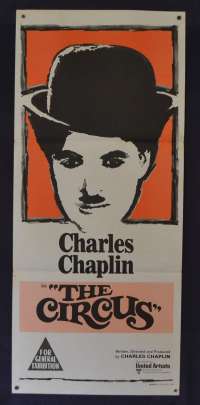
The Circus is a 1928 silent film written and directed by Charlie Chaplin with Joseph Plunkett as an uncredited writer. The film stars Chaplin, Al Ernest Garcia, Merna Kennedy, Harry Crocker, George Davis and Henry Bergman. The ringmaster of an impoverished circus hires Chaplin's Little Tramp as a clown, but discovers that he can only be funny unintentionally, not on purpose. The production of the film was the most difficult experience in Chaplin's career. Numerous problems and delays occurred, including a studio fire, the death of Chaplin's mother, as well as Chaplin's bitter divorce from his second wife Lita Grey, and the Internal Revenue Service's claims of Chaplin's owed back taxes, all of which culminated in filming being stalled for eight months. The Circus was the seventh highest grossing silent film in cinema history taking in more than $3.8 million in 1928. The film continues to receive high praise.

Poster artwork by Mike Vaughan.Blood from the Mummy's Tomb is a 1971 Horror British film starring Andrew Keir, Valerie Leon, and James Villiers. This was director Seth Holt's final film, and was loosely adapted from Bram Stoker's novel The Jewel of Seven Stars. The film was released as the support feature to Dr. Jekyll and Sister Hyde. Writer Chris Wicking says the film was one of the last projects that James Carreras brought to Hammer Film Productions. Peter Cushing was cast in the film and completed one day's filming before leaving the production after his wife was diagnosed with emphysema. Cushing was replaced by Andrew Keir. Director Seth Holt died of a heart attack five weeks into the six-week shoot, collapsing into cast member Aubrey Morris's arms and dying on set. Despite its troubled production, the film received critical praise with AllMovie's review of the film commending its "glamorous style" and "creepy atmosphere".

Daybill Poster.The Nanny is a 1965 British suspense film directed by Seth Holt, and starring Bette Davis, Wendy Craig, and Jill Bennett. Davis appears as a supposedly devoted nanny caring for a 10-year-old boy recently discharged from a home for disturbed children. It is based on the novel of the same title by Evelyn Piper (a pseudonym for Merriam Modell), and the film was scored by Richard Rodney Bennett. The film was made by Hammer Film Productions at Elstree Studios. The Nanny was well received by critics as being "one of Hammer Films' better non-supernatural outings of the 1960s".

Rosemary's Baby is a 1968 American psychological horror film written and directed by Roman Polanski, based on Rosemary's Baby by Ira Levin. The cast features Mia Farrow, John Cassavetes, Ruth Gordon, Sidney Blackmer, Maurice Evans, Ralph Bellamy, Angela Dorian, Clay Tanner, and, in his feature film debut, Charles Grodin. The film chronicles the story of a pregnant woman who suspects that an evil cult wants to take her baby for use in their rituals. Rosemary's Baby deals with themes related to paranoia, women's liberation, Christianity (Catholicism), and the occult.The film earned almost universal acclaim from film critics and won numerous nominations and awards. Polanski envisioned Rosemary as a robust, full-figured, girl-next-door type, and he wanted Tuesday Weld or his own then-fiancée Sharon Tate for the role. Robert Redford was the first choice for the role of Guy Woodhouse, but he turned down the offer. Jack Nicholson was considered briefly before Polanski suggested John Cassavetes. Ruth Gordon won the Academy Award for Best Supporting Actress for her performance in this film. Farrow's performance garnered numerous awards, including the Golden Globe Award for New Star of the Year – Actress, and established her as a leading actress. Today, the film is widely regarded as a classic.

War and Peace (Italian: Guerra e pace) is a 1956 American-Italian war drama film directed by King Vidor and written by Vidor, Bridget Boland, Mario Camerini, Ennio De Concini, Gian Gaspare Napolitano, Ivo Perilli, Mario Soldati, and Robert Westerby based on Leo Tolstoy's 1869 novel of the same name. The film, released by Paramount Pictures, was produced by Dino De Laurentiis and Carlo Ponti with a music score by Nino Rota and cinematography by Jack Cardiff. The film stars Audrey Hepburn, Henry Fonda, and Mel Ferrer, along with Vittorio Gassman, Herbert Lom, John Mills and Anita Ekberg, in one of her first breakthrough roles. It had Academy Awards nominations for Best Director (King Vidor), Best Cinematography, Color (Jack Cardiff) and Best Costume Design, Color (Maria De Matteis).

Daybill Poster.Robin and the 7 Hoods is a 1964 American musical film directed by Gordon Douglas and starring Frank Sinatra, Dean Martin, Sammy Davis Jr. and Bing Crosby. The picture features Peter Falk, Barbara Rush, and an un-credited Edward G. Robinson. Written by David R. Schwartz, the film transplants the Robin Hood legend to a 1930s Chicago gangster setting, though this story's utterly opportunistic Marian is very different from the faithful Maid Marian of the original legend. Produced Sinatra, the film introduced the hit song "My Kind of Town" by Jimmy Van Heusen and Sammy Cahn, which was nominated for an Academy Award for Best Original Song and achieved a career of its own independent of the film.
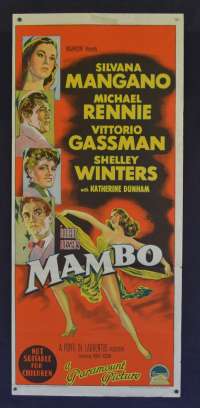
Mambo is a film written and directed from 1952 to 1953 by Robert Rossen and released in 1955. A mambo craze spread through the USA in the 1950s, and Rossen aimed to repair his finances after almost two years without work since his 1951 House Un-American Activities Committee hearing. The film stars Silvana Mangano as Giovanna Masetti, a poor Venetian who is admired by the crafty croupier Mario Rossi (Vittorio Gassman) and the rich count Enrico Marisoni (Michael Rennie). Giovanna lives out a dream to become a dancer and moves to Rome. She returns six months later to the competing affections of Mario and Enrico, resulting in a choice between the two and the dramatic finale. The New York Times praised Rossen's skillfully created moods, some decadent and others melancholy.
| PO Box 491 Sherwood, 4075, Brisbane Queensland, Australia |
|
| 0419 736 441 | |
| MON - FRI - 9am to 5pm | |
| This email address is being protected from spambots. You need JavaScript enabled to view it. |

