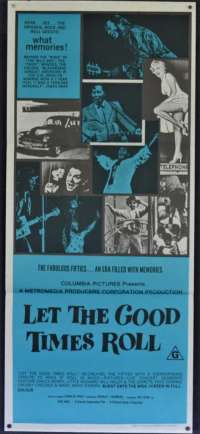
Daybill Poster with rare blue art.Let the Good Times Roll is a 1973 rockumentary / concert film directed by Robert Abel and Sidney Levin. It features numerous stars from the American pop and rock music scene of the 1950s. The film follows a concert in the 1970s, interspersed with footage of the singers from the 1950s. It also includes interviews with the singers. The film ends with a rare, and apparently impromptu, duet between Berry and Diddley, who had recorded together before, but were not often filmed on stage together. Critics have said that Let the Good Times Roll is one of the "few movies about '50s rock that well and truly rocks".
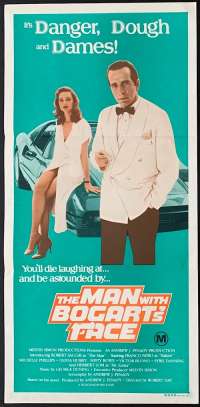
Daybill Poster.The Man With Bogart's Face (also called Sam Marlowe, Private Eye) is a 1980 American comedy film, released by 20th Century Fox and based on a novel of the same name. Andrew J. Fenady, author of the novel, produced the film and wrote the screenplay. The film was based on the debut novel by Andrew J. Fenady who wrote it in long hand over 23 days. The film was made in May 1979 with independently raised finance from Melvin Simon Productions. Star Robert Sacchi was noted for his resemblance to Bogart, and had appeared as Bogart in various roles for over a decade, including various commercials, a Broadway production of Play It Again Sam. He had toured America for four years in a one man show Bogie's Back. The film debuted at the 1980 Cannes Film Festival and was released in Europe before debuting in the US. The New York Times called it "an intelligent, amiable and often amusing spoof of Humphrey Bogart and the roles he played".

Daybill Poster with colourful artwork by Larry Salk.Mr. Ricco is a 1975 crime drama film directed by Paul Bogart and starring Dean Martin in his last leading film role, along with Eugene Roche, Denise Nicholas and Cindy Williams. Dean Martin appeared in Mr. Ricco as his contract for appearing at the MGM Grand Hotel in Las Vegas included a commitment to star in a film for MGM.. Paul Bogart signed to direct the film in early 1974, at which stage the film was called Ricco.
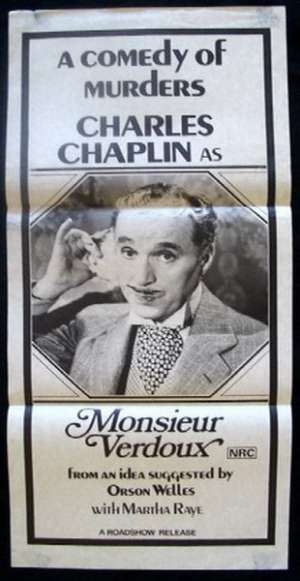
Daybill Poster.Monsieur Verdoux is a 1947 American black comedy film directed by and starring Charlie Chaplin, who plays a bigamist wife killer inspired by serial killer Henri Désiré Landru. The supporting cast includes Martha Raye, William Frawley, and Marilyn Nash. This was the first feature film in which Chaplin's character bore no resemblance to his famous "Tramp" character (The Great Dictator did not feature the Tramp, but his "Jewish barber" bore some similarity). While immediately after the end of World War II on both sides of the Atlantic Ocean appeared a spate of films, including in 1946 It's a Wonderful Life and A Matter of Life and Death, which drew on so many people's experiences of loss of loved ones and offered a kind of consolation, Monsieur Verdoux had an unapologetically dark tone, featuring as its protagonist a murderer who feels justified in committing his crimes. The film was nominated for the 1947 Academy Award for Best Original Screenplay. It also won the National Board of Review award for Best Film and the Bodil Award for Best American Film. In the decades since its release, Monsieur Verdoux has become highly regarded.

The Rabbit Trap is a 1959 American drama film directed by Philip Leacock based on a 1955 Goodyear Television Playhouse teleplay by JP Miller. Story line of the film was as such: Job or family? This perennial conflict portrayed in this drama about a draftsman, able to free himself from the job for a very overdue family vacation, who is then threatened with the sack if he doesn't return to work mid-holiday. Stars Ernest Borgnine and Don Rickles.

Alibi 1942 one of the classic film noir of its generation starring a very young James Mason along side Margaret Lockwood and Hugh Sinclair. The colorful, dynamic artwork in this poster is reminiscent of the covers of pulp detective and crime novels of the 20's and 30's, from which many of the film noir stories were born. Though the movies were black and white, the posters were rich with color as can be seen by this rare item.

The Mysterious Island Of Captain Nemo was originally a 1973 European TV miniseries production lasting 300 minutes and adapted from Jules Verne's novel L'Île mystérieuse. It was later re-edited into a 96-minute motion picture for theatrical release. This version was directed by Juan Antonio Bardem and Henri Colpi and featured Omar Sharif as Captain Nemo. This French film is one of the many efforts to film Jules Verne's novel, Mysterious Island. Sharif’s portrayal of Nemo was one of a seriously misanthropic man, who hides near a tropical island in his fabulous submarine. Flying in on a balloon are a number of refugees from a military dictatorship. The heroes of the story escape as Nemo battles pirates and an erupting volcano. This version turned out to be one of the most remarkable Jules Verne adaptations, remaining unusually faithful to the original book, including the exterior design of the Nautilus.

Daybill movie poster.The Go-Between is a 1971 British period drama film directed by Joseph Losey. Its screenplay by Harold Pinter is an adaptation of the 1953 novel The Go-Between by L. P. Hartley. The film stars Julie Christie, Alan Bates, Margaret Leighton, Michael Redgrave and Dominic Guard. It won the Palme d'Or at the 1971 Cannes Film Festival. Filming started in August 1970.The film was shot at Melton Constable Hall, Heydon and Norwich in Norfolk. Filming wound up in November. The film was first shown in May 1971 at the Cannes Film Festival, and it won the Grand Prix International du Festival. It won various Academy Awards and was nominated for others.

H.M.S. Defiant Australian Daybill Movie Poster| Defiant's crew is part of a fleet-wide movement to present a petition of grievances to the Admiralty. Violence must be no part of it. The continual sadism of Defiant's first officer makes this difficult, and when the captain is disabled, the chance for violence increases.
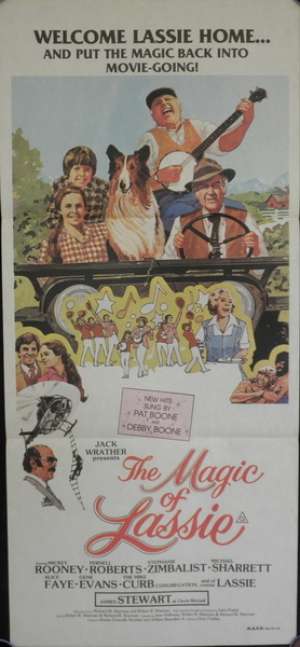
Daybill Poster.The Magic of Lassie is a 1978 American family musical drama film directed by Don Chaffey, starring Lassie, James Stewart, Stephanie Zimbalist, Pernell Roberts, and Michael Sharrett, with cameo appearances by Mickey Rooney and Alice Faye (in her final film appearance). James Stewart is featured in one of only three musical film roles that he played: the first was Born to Dance (1936) in which he introduced the Cole Porter standard "Easy To Love" and the second was Pot O' Gold (1941). This was also his final onscreen appearance in a live-action film. The screenplay and song score are supplied by the prolific Sherman Brothers, who worked as staff songwriters for Walt Disney and wrote songs for his films such as Mary Poppins (1964). Their song "When You're Loved" was nominated for an Academy Award for "Best Original Song" and was sung by Debby Boone. It is also the only musical film featuring Lassie. The film was shot from September 19 to late November 1977 on location in Sonoma County, California at Hop Kiln Winery, Griffin Vineyard on Westside Road, Healdsburg, California.Other locations included Boomtown in Reno, Nevada and Zion National Park in Utah. On July 27, 1978, the world premiere of The Magic of Lassie was held at Radio City Music Hall in New York City and broke a box-office record, grossing $40,673.75 on its opening day. It was released in New York on August 2 and nationwide on August 18. It opened in Los Angeles on December 8, 1978.

Mountain Rhythm Daybill Rare Poster Original 1943.Mountain Rhythm (Harvest Days as it was released in the UK) is a 1943 American comedy film directed by Frank McDonald and written by Dorrell McGowan and Stuart E. McGowan. The film stars Leon Weaver, Frank Weaver, June Weaver, Lynn Merrick, Frank M. Thomas and Sally Payne. The film was released on January 8, 1943, by Republic Pictures. The basic storyline is as follows: The Weaver family buys some farmland in California, but the headmaster of a nearby boy’s school doesn't want them as neighbours. Before long the boys at the school are causing trouble for the Weavers.
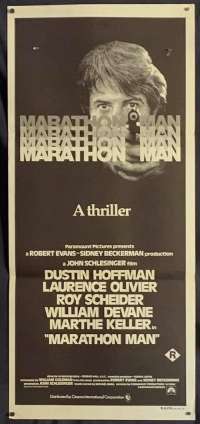
Daybill Poster. Marathon Man is a 1976 American suspense-thriller film directed by John Schlesinger. It was adapted by William Goldman from his 1974 novel of the same title and stars Dustin Hoffman, Laurence Olivier, Roy Scheider, William Devane and Marthe Keller. Laurence Olivier was cast early on. However, he had health problems and at one stage, it was uncertain whether he would be able to do the film. Richard Widmark auditioned for the part, but Olivier eventually recovered and was able to participate in filming. Olivier and Hoffman did not get on due to Hoffman’s ‘Method’ style of acting. The movie was filmed from October 1975 to February 1976. The film was a financial and critical success. Olivier's performance was particularly praised: he was nominated for an Oscar for Best Actor in a Supporting Role and he won a Golden Globe in the same category.
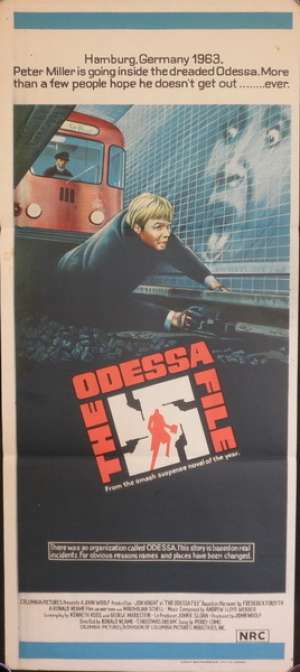
Daybill Poster.The Odessa File is a 1974 thriller film, adapted from the 1972 novel of the same name by Frederick Forsyth.It is set in Hamburg in the winter of 1963. Jon Voight plays Peter Miller, a German reporter who is investigating the whereabouts of missing Nazi war criminals. After reading the diary of a Holocaust survivor who has recently committed suicide, Miller goes on the trail of in-hiding SS officer Eduard Roschmann (Maximilian Schell). The reporter finds his investigation blocked by members of a secretive group called Odessa. With the help of Israeli activists, Miller persists in his search. The film also stars Mary Tamm, Derek Jacobi and Maria Schell and it was directed by Ronald Neame (The Poseidon Adventure). The film score was done by Andrew Lloyd Webber. Filming was done on location in Germany, Austria and at the studios at Pinewood in England and the Bavaria in Grünwald, Bavaria, Germany. The film's title song, "Christmas Dream", is sung by Perry Como and the London Boy Singers.

Daybill Poster.Josephine and Men is a 1955 British Boulting Brothers gentle comedy film directed by Roy Boulting and starring Glynis Johns, Jack Buchanan, Donald Sinden and Peter Finch. It also features William Hartnell, Gerald Sim, Thorley Walters, Victor Maddern and John Le Mesurier in supporting roles.The storyline was as such: In this romantic comedy, a womanizing uncle tells the story of his good-hearted but fickle niece, whose tendency to always champion the underdog causes her endless romantic woes. It all begins when she breaks up with her fiance on the eve of their wedding so she can marry and help out a half-starved aspiring playwright. With her moral support and his talent, the playwright makes it big. Unfortunately, her old fiance shows up. He has lost his fortune and must flee the police. The tender-hearted lass, unable to resist a hard-luck story, then falls for her former love until he is proven innocent. It is at that point that the niece chooses her man once and for all.

Not Wanted Daybill Poster Original 1949.Twentyish Sally Kelton is unhappy at home and in the drab town in which she lives, until she meets roving musician Steve Ryan. Sally falls for Steve, but to Steve, she's just another fling before he heads to another town. Sally decides to "pull up stakes" and heads on a bus to Steve's next stop. On the road, she meets Drew Baxter, owner of a gaseteria in the town where she's heading. Drew sets Sally up with a room at a local boarding house and a job at his business. Try as he might, Drew can't win Sally's heart from Steve, who has remained indifferent to Sally since her arrival. When Steve heads off to South America, Sally is even more despondent--especially after she learns that she's pregnant with his child.

Daybill poster.The H-Man known in Japan as Beauty and Liquid Men is a Tokusatsu film produced and released by Toho Studios in 1958. The film was made by Toho's legendary Godzilla directing/special effects/producing team of Ishirō Honda, Eiji Tsuburaya, and Tomoyuki Tanaka.This, like such films as The Human Vapor, and Matango, was one of Honda and Tsuburaya's forays into science fiction without kaiju or giant monsters. Instead, the story focuses on mobsters, nightclub singers, and radioactive liquid creatures that live in Tokyo's sewers, which are the results of a nuclear explosion. The film was released by Columbia Pictures in the United States in 1959. A New York Herald Tribune film critic at the time called it, "A good-natured poke at atom-bomb tests... The picture is plainly making a case against the use of nuclear bombs. At the same time, there is a great deal of lively entertainment in the story involving police, dope smugglers, scientists and some very pretty Japanese girls. Rarely does this daybill become available.
| PO Box 491 Sherwood, 4075, Brisbane Queensland, Australia |
|
| 0419 736 441 | |
| MON - FRI - 9am to 5pm | |
| This email address is being protected from spambots. You need JavaScript enabled to view it. |

